
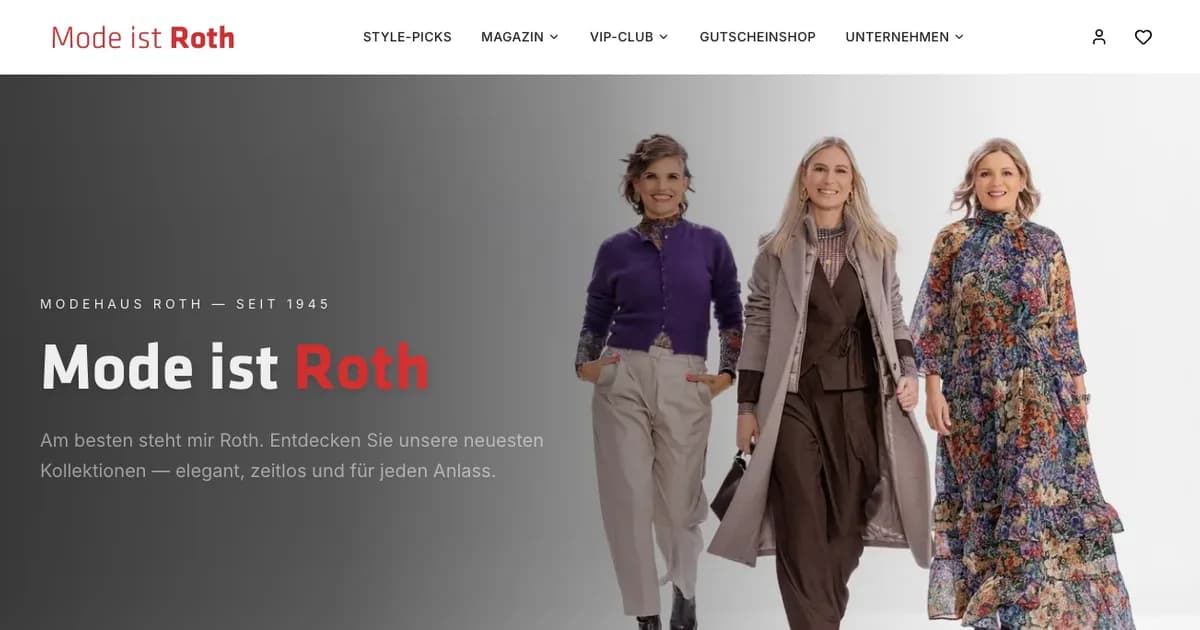
When the website becomes a working tool
A website for a fashion retailer is quickly built: pictures, collection, store locations. Modehaus Roth wanted more. The family business from Styria has been dressing its region since 1945, runs 11 stores today and lives on personal advice. The website was not meant to sit beside the business but to become part of it.
As of today the result is live: moderoth.at.
The starting point
Anyone running several stores knows the problem: the truth lives in the inventory system. Which piece is in which size in which store? A website that does not know can only be a brochure. On top of that came vouchers, appointments for personal advice, a VIP club, and a team that wants to maintain content without calling a developer every time.
Five decisions that shape the platform
1. Style-Picks instead of a product catalogue
Nobody buys fashion from a list. That is why curated outfits sit at the centre at Roth: looks of several pieces, with image and video galleries. The matching items hang right off them. Inspiration first, product second.
2. Live stock instead of shop-window promises
Stock per store is synchronised automatically with the retailer's inventory system. That sounds like technology in the background, but it decides trust: anyone who sees a piece online should find it in the store.
3. Reserve online, try on in store
Customers reserve a piece in their store of choice. The team confirms in the admin area, and everyone stays informed by email. The platform leads people into the store instead of past it. That is exactly right for a house that lives on personal advice.
4. Voucher shop with online payment
Vouchers can be bought and paid online, in several designs, as a PDF or directly by email to the recipient. They are redeemed in every store. Existing vouchers were carried over into the new system so that nobody loses anything.
5. An admin area the team runs itself
Reservations, vouchers, appointments, opening hours, store details, job ads, magazine articles and social posts for Facebook and Instagram: the team maintains all of it itself. A platform that only the developer can operate becomes a problem within a year. One the team understands stays a tool.
Technically: Next.js and operations that never pause
We built with Next.js and Supabase, and payments run through Mollie. More important than the names is what happens in the background: stock synchronisation, payments and monitoring keep running while the stores do their work.
Care also went into places nobody sees: a clean move from the old web address so search rankings survive, and the legal requirements of Austrian retail, including the withdrawal button and consent management.
What this project shows
For businesses with several locations, the website is no longer a business card. It is the place where stock, appointments and payments come together. That cannot be pulled from a page builder. It takes someone who understands the daily life of the business and translates it into software.
If you would like to see the result: moderoth.at. The case study shows the details.
And if you run a business with several locations and want to connect your daily operations with the web: get in touch. The first conversation is free and non-binding.