
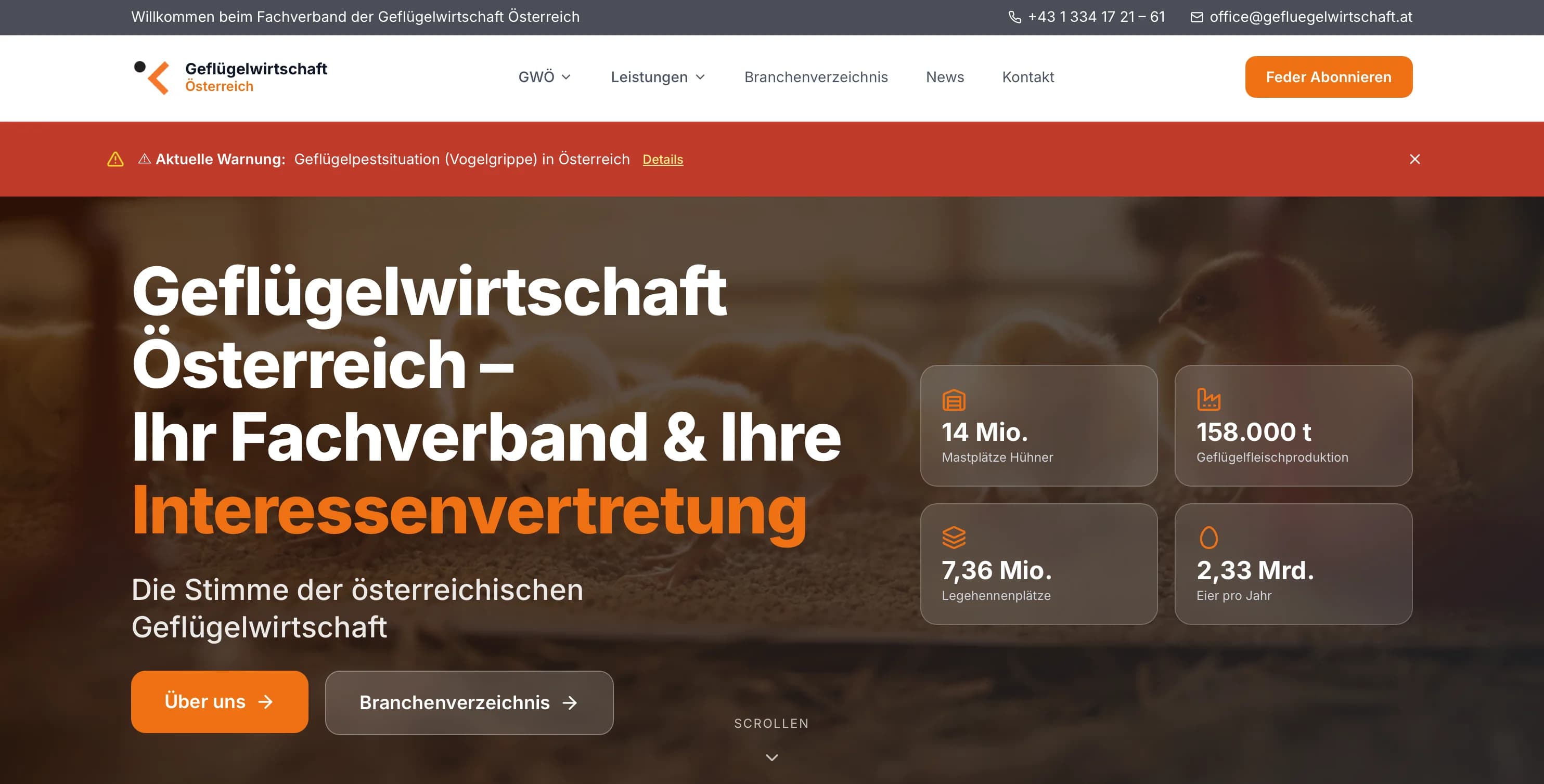
A project that had substance from the start
When an association comes to us that represents the interests of the entire Austrian poultry industry — producers, processors, traders — one thing is clear: this is not about a business card. This is about digital infrastructure used daily by members, journalists, politicians and the interested public.
That was exactly the task with Geflügelwirtschaft Österreich: Austria's poultry industry association needed a web presence that does justice to its significance. Professional, fast, clearly structured — and built so that the in-house team can manage content themselves, without calling a developer every time.
What the old website couldn't do
The starting point was easy for us to understand: a website that had grown over the years, filled with content without the structure growing alongside it. The member directory was hard to navigate. Current news and statistics were buried. On a smartphone, the site was barely usable.
But the real problem wasn't technical — it was strategic. The website failed to communicate what the association actually does. EU-level lobbying, educational offerings, industry statistics, events — all of it was there, but none of it was visible.
An industry association that's invisible can't deliver value to its members.
That was our starting point.
The three core decisions in the concept
Before we wrote a single line of code, we clarified three fundamental questions with the association:
1. Who are the target groups — and what does each need?
Geflügelwirtschaft Österreich speaks simultaneously to three very different audiences:
- Members want quick access to current information, statistics and association news
- Journalists and policymakers need contacts, press materials and reliable figures
- The interested public looks for background information on the industry, animal husbandry and food
A website that serves all three groups with the same navigation and the same content works for none of them well. We built the information architecture so each group finds what they need within two clicks — without scrolling through irrelevant content.
2. How does the team manage content themselves?
Associations rarely have their own developers. What they do have: dedicated staff who regularly want to publish news, update statistics and list events — and they should be able to do this without technical knowledge.
We set up content management so that new articles, member entries and statistics can be maintained directly in the backend. No ticket to the agency, no waiting for a developer. The association is now completely self-sufficient.
3. What is the one piece of content every visitor immediately finds?
The industry directory. Anyone searching for a poultry business in Austria — whether as a buyer, journalist or consumer — should find it immediately. Full-text search, filtering by category and region, cleanly structured entries for every member company.
That was the content guiding principle for the entire website.
Technically: Next.js as the foundation
For the implementation we chose — as with all our projects — Next.js. The reasons are the same ones that always bring us back to it:
- Server-side rendering ensures every page loads instantly — even on slower mobile connections
- Optimised image processing with next/image reduces load times without quality loss
- Clean URL structure gives Google and other search engines clear signals
- Scalability — if the association grows, the website can grow with it seamlessly
The result: Lighthouse scores above 90 across all categories. For an association that wants to be visible in searches for terms like "Austrian poultry industry", "egg production Austria" or "poultry businesses Austria", this is not a luxury — it's a basic requirement.
The design: competence you can see
For an association, design is a positioning decision. Too bureaucratic looks off-putting. Too playful doesn't match the gravitas of an industry body. We found a middle ground: professional and clear, but approachable and modern.
Few colours, strong typography, generous whitespace. No distracting animations, no cluttered navigation structures. The content takes centre stage — not the design.
What sounds unspectacular at first is in practice the harder discipline: building a design that never gets in the way, yet immediately conveys trust.
What went live after six weeks
From the first briefing to launch, we needed six weeks. In that time we built:
- A completely redesigned information architecture
- A searchable industry directory with all member companies
- A dynamic news system that the team manages themselves
- Dedicated sections for statistics, events and press materials
- A fully responsive website that works on every device
- SEO foundations with clean metadata, structured data and optimised URLs
This was not a small project. And we're proud of how it turned out.
What we took away from this project
Association projects are different from company websites. The requirements are broader, the target groups more diverse, and content must stay current for years — not just in the first weeks after launch.
What we're particularly proud of here: the combination of structured information architecture and ease of maintenance. The association can now work independently. The website is not a final product — it's a living system.
If you'd like to see the result: gefluegelwirtschaft.at
And if you have similar requirements — whether an association, institution or company with complex content — get in touch. The first conversation is free and non-binding.